How to Stay Sane While Robots Eat Your Job
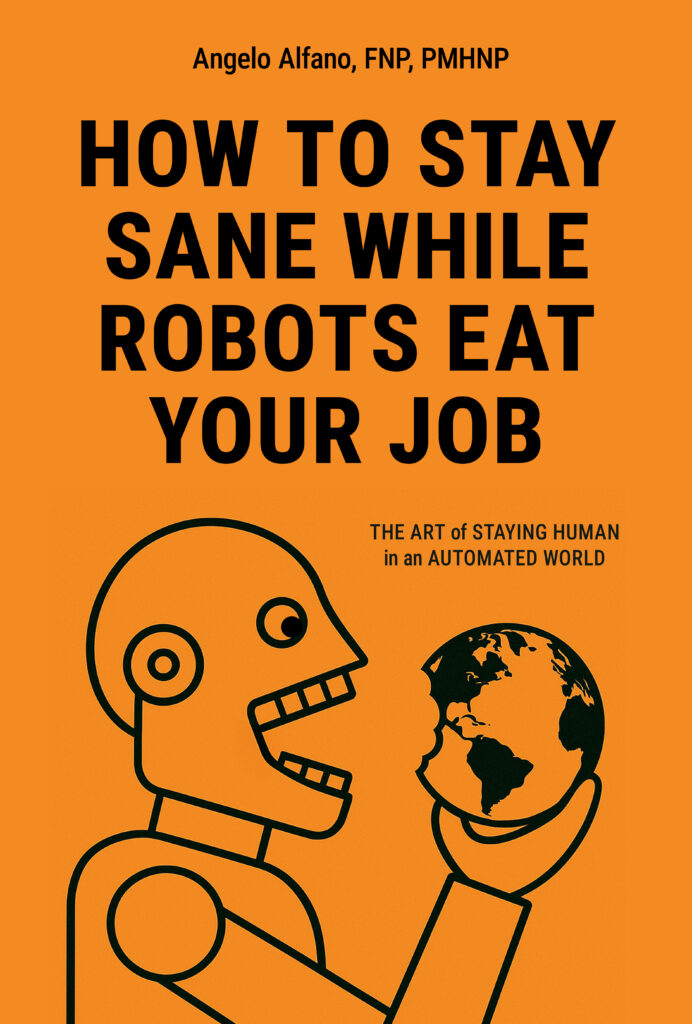 Published by: Munn Avenue Press
Release Date: Spring 2026
OVERVIEW
How to Stay Sane While Robots Eat Your Job is a darkly funny, clinically grounded survival guide for navigating the psychological chaos of the AI revolution. Drawing from thousands of patient encounters and the emerging science of technological stress, psychiatric nurse practitioner Angelo Alfano breaks down how automation, burnout, and digital overload are reshaping the human mind—and what to do about it. Blending neuroscience, humor, and real therapeutic tools, Alfano introduces AI-Induced Stress Syndrome (AISS), a modern condition born from living in a world optimized for speed, fear, and disruption. Through evidence-based strategies, irreverent storytelling, and an unflinching look at modern anxiety, this book helps readers reboot their mental operating systems, rebuild resilience, and stay human in an era increasingly run by machines. Equal parts insight and comic relief, it’s a field guide for anyone trying to stay grounded while the algorithms rearrange the world.
PRAISE
"The world is changing rapidly and not surprisingly, the change, as it always does, is both exciting and is creating anxiety. Angelo Alfano is a brilliant mental health clinician and a keen observer of how social media and particularly Artificial Intelligence is creating both opportunities and mental health struggles for us all. He has written a wonderful book that can serve as a guide on how to both prepare for and navigate through the dramatic changes we are all facing. I recommend immediately ordering and reading this book so you have a chance to put on your seat belt and enjoy the ride."
–Dr. Kenneth Robbins, MD
EXCERPT
From Chapter 1: Welcome to the Disruption
I’m a psychiatric nurse practitioner. That means I spend most of my days talking with real people about real problems—the kind you can’t fix by yelling at customer service or doubling your caffeine intake. I work in a clinic where emotional breakdowns are common, but lately the breakdowns have a different flavor. Something heavier. Something sharp-edged and ambient, like dread left out overnight.
Over the past few months, I’ve seen a surge in anxiety, depression, disorientation, and a very specific brand of existential crisis. Sure, some of it is political chaos (read: our jackass of a president), but that alone doesn’t explain everything. There’s a deeper tremor running through people. Not just about the present—about what comes next. The inevitable “Oh God, I just got replaced by a robot” moment.
That thing is artificial intelligence.
I’m not a doomsayer. I see the good in AI. I also see the deeply stupid, the wildly irresponsible, and the economically catastrophic. I’m a realist—the kind who reads clinical journals and occasionally stares out the window wondering what happens to therapists when a language model starts giving surprisingly good relationship advice.
This book is my attempt to offer something useful before the next wave hits—a few handholds, a little scaffolding, and just enough sarcasm to keep you from screaming into the void. Because make no mistake: AI isn’t a gentle nudge. It’s a stick of dynamite wrapped in a TED Talk.
As Erik Brynjolfsson put it, “AI won’t just replace jobs — it will transform them, forcing us to rethink what it means to be valuable in the workplace.” And it’s already happening.
What I hope to do here is help you stay human through it. Not perfect, not enlightened—just grounded, resilient, and maybe laughing a little as the algorithms tighten their grip. We’ll walk through real tools—not euphoric Instagram “life hacks,” but practical cognitive frameworks, body-based practices, and a few psychological crowbars to pry yourself off the floor. And I’ll try to keep it honest enough to be useful and dark enough to make your therapist nervous.
The AI Avalanche
AI has arrived not as a cute assistant that alphabetizes your bookshelf, but as a tireless overachiever who doesn’t take lunch breaks, doesn’t get sick, and is disturbingly comfortable stealing your job. It’s not evil. It’s just efficient and immune to hangovers.
In the early days, AI wrote mediocre poems and occasionally crashed a car. Now it edits films, drafts briefs, diagnoses illnesses, gives financial advice, and just casually passed the California Bar Exam. Meanwhile, you can’t figure out where Netflix moved the home button.
This isn’t just technological disruption—it’s psychological unmooring. Every new AI headline feels like a tiny eviction notice from your own identity. If you’re in a knowledge profession—law, medicine, education, therapy—AI isn’t encroaching on your job. It’s outperforming parts of it without needing health insurance or validation.
As Anthropic CEO Dario Amodei warned, AI could eliminate up to 50% of entry-level white-collar jobs within the next five years.
So yes, your anxiety makes sense.
The Human Response: Dread, Coffee, and Doomscrolling
Your coping strategies may already be familiar: coffee, more coffee, passive-aggressive emails, hobby hoarding, bourbon, or the occasional fantasy of living in the forest eating lentils. It’s funny until it’s not—until your sense of worth starts to fray because the work you trained for has become optional software.
IBM estimates 120 million workers will need retraining in the next three years due to AI. You are not imagining the shift. You are living in it.
A Clinical Look at the Chaos
Humans are wired for predictability, connection, and competence. AI threatens all three at once. What you’re feeling is not burnout from working too hard—it’s burnout from feeling replaceable inside a system you don’t control.
Psychologists call this anticipatory grief. You’re mourning a future self you may never become.
It shows up in your mood, your attention span, your confidence, even your parenting. It’s hard to be a grounded caregiver when your kid’s tablet knows their bedtime routine better than you do.
AI-Induced Stress Syndrome (AISS)
It’s time we name what’s happening.
AISS is a proposed psychological framework describing the anxiety, irritability, cognitive fragmentation, and identity disruption caused by rapid technological acceleration. Think of it as burnout with a technological accelerant and an existential aftertaste.
Symptoms include:
• intrusive thoughts about being replaced
• compulsive upskilling or doomscrolling
• sleep disruption and digital fatigue
• emotional numbness when your job title appears in a tech demo
• a sudden urge to homestead
If that sounds familiar, congratulations—you may be experiencing a very normal response to a profoundly abnormal moment in history.
So What Do We Do?
We adapt. Imperfectly. Clumsily. Humanly.
This book will teach you how. You’ll learn to:
• decatastrophize your spiraling thoughts
• rebuild attention in a world designed to steal it
• understand burnout as neurobiology, not personal failure
• move your body as emotional regulation, not punishment
• use humor as psychological armor
• build resilience when the world feels unstable
• The human condition has always been built for chaos. This era is simply faster and better lit.
You can still respond—with clarity, with grit, with irreverence, and with the stubborn refusal to let the robots have the last word.
Let’s begin.